Why You Hesitate on NCLEX Questions
You're not struggling with knowledge.
Most students who hesitate on NCLEX questions assume the problem is:
- Not knowing enough content
- Needing more practice questions
- Needing to study harder
That's usually not the problem.
The real issue is how you make decisions under pressure.
Why It Feels Right
The hesitation instinct makes sense.
In real clinical practice — and in life — we're taught to be cautious before acting, verify before committing, and avoid mistakes by thinking things through.
So when you're uncertain, your brain says: don't act until you're certain. That's good judgment in most situations.
Why It Fails on NGN
The Next Gen NCLEX is not testing caution. It's testing clinical judgment under pressure.
In prioritization and deterioration scenarios, waiting is the mistake. Patients in these questions are often deteriorating, unstable, or at immediate risk.
Delaying action while you wait for certainty means the patient gets worse.
This is why students who know the content still hesitate to the wrong answer — the instinct to be certain before acting is the exact reflex NGN is designed to surface.
This is one of the most common patterns we see across thousands of sessions.
Pattern Identity
If this feels familiar — if you frequently second-guess your first instinct and end up with the wrong answer — you're not alone. Most students default to this pattern. The pressure to be certain before acting is deeply trained.
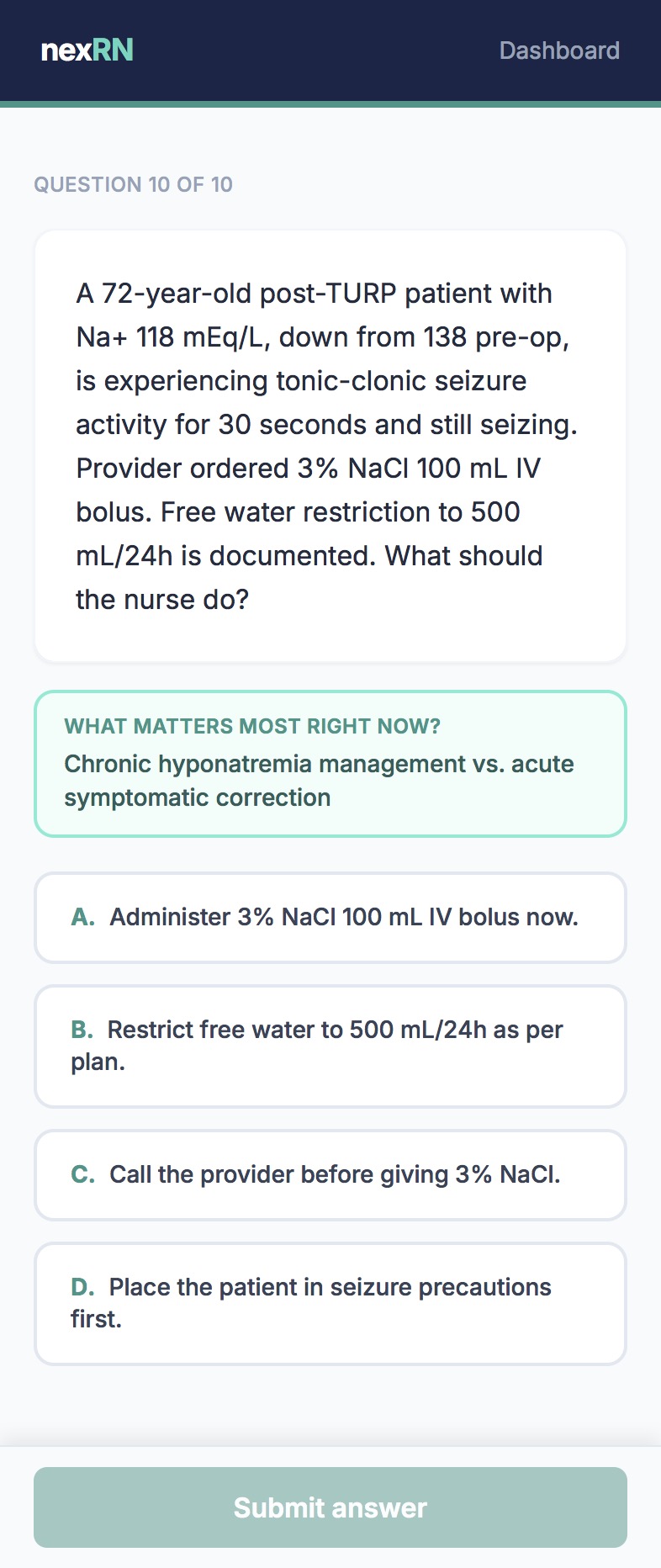
What It Looks Like in Practice
The first student waits for certainty. The second student acts on the clinical picture.
Why More Questions Don't Fix It
You can complete 1,000 — even 3,000 — practice questions and still make this mistake. Because you're repeating the same thinking pattern in every question.
Volume does not fix a decision error. Practicing the decision fixes it.
nexRN trains the clinical judgment the NCLEX actually tests — 10 questions per session, every day.
Try a free session at nexrn.ai