Why You Can Fail the NCLEX With a High UWorld Score
Your UWorld percentage is in the 60s. You've done over a thousand questions. You've read every rationale. You feel ready.
You sit for the NCLEX — and nothing feels like what you practiced.
This is one of the most frustrating outcomes in NCLEX prep.
Why It Feels Right
"Do UWorld" is the advice in every Reddit thread, every study group, every nursing school orientation. Students who passed used it. Your instructors recommended it. A high percentage must mean you're prepared. The correlation feels obvious.
Why It Fails on NGN
UWorld trains a specific cognitive loop: read a question, identify the correct answer within a multiple-choice format, absorb the rationale. The more questions you do, the better you get at that loop.
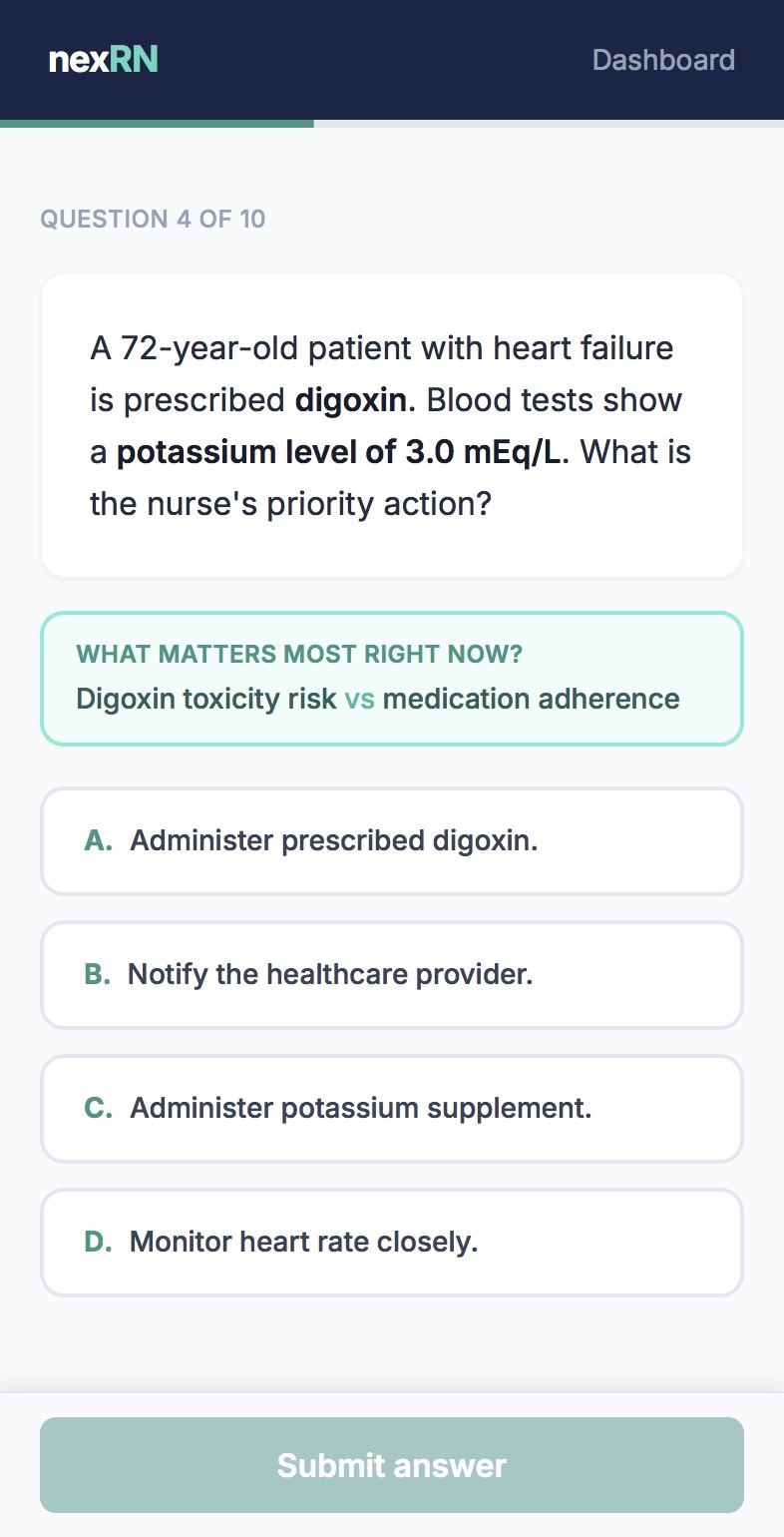
NGN tests something different. It presents ambiguous clinical scenarios — situations where two answers are both clinically defensible — and evaluates whether you can apply a specific decision rule to determine which action wins.
That is not the same task.
Getting good at UWorld means you've learned to recognize patterns within UWorld's format. It does not mean you've trained the clinical judgment NGN requires.
This is why students with high UWorld scores are blindsided by the actual exam. They prepared for a test that no longer exists.
Pattern Identity
If your UWorld score is strong but you still feel uncertain walking into the exam — that uncertainty is telling you something real. You've built one skill. The NCLEX is testing a different one. This is one of the most common gaps in NGN preparation.
What It Looks Like in Practice
The first student measured their score. The second student measured their judgment.
Why More Questions Don't Fix It
The natural response to feeling underprepared is: do more questions. But if the questions aren't training the cognitive task NGN evaluates, more questions widen the wrong skill and leave the right one untrained.
Volume of the wrong kind of practice doesn't substitute for the right kind.
nexRN trains the clinical judgment the NCLEX actually tests — 10 questions per session, every day.
Try a free session at nexrn.ai